
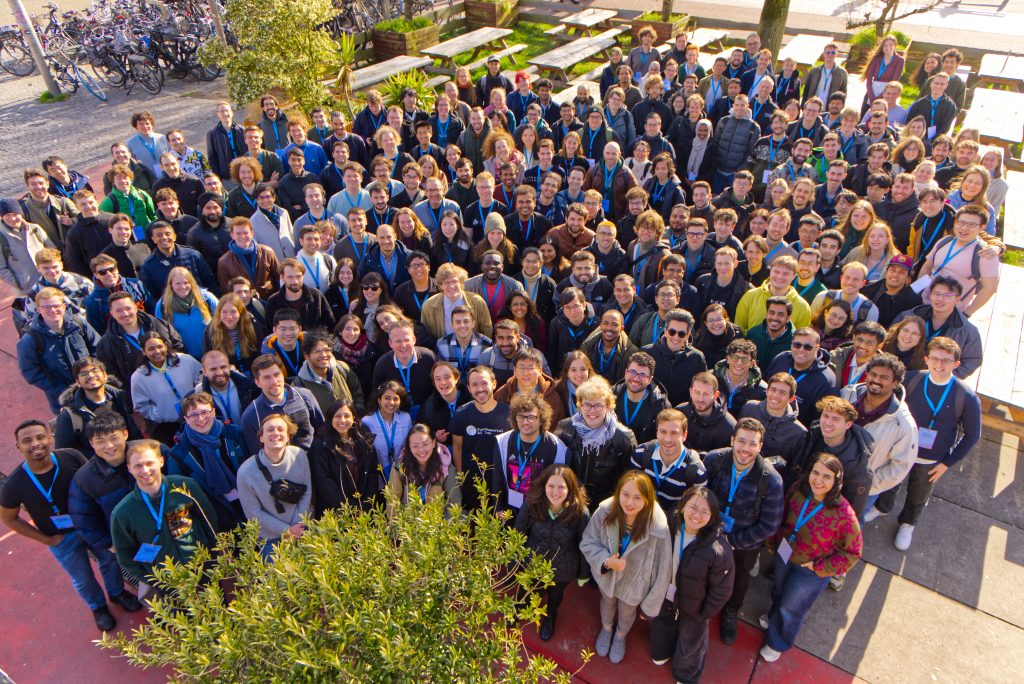
The ELLIS ELIAS ELLIOT Winter School on Foundation Models (FoMo) 2026 brought 260 young researchers from 128 institutions worldwide to Amsterdam, with particularly strong representation from across Europe. The school was hosted by the ELLIS unit Amsterdam at the Tolhuistuin, Amsterdam North, from 24-27 March 2026. Initiated in 2024, the Winter School is “for the curious-minded, for those that want to build the next frontier of models, that want to analyze how they behave, and to see them deployed in a responsible manner, and to have a European network of peers and researchers,” explains Yuki Asano (ELLIS Scholar, University of Nuremberg, Co‑organiser of the FoMo School).
Building on this mission, the 2026 edition highlighted emerging trends and directions in foundation models. Cees Snoek (ELLIS Fellow, University of Amsterdam, Co‑organiser of the FoMo School), noted that alongside work on hyperbolic and tabular foundation models, a particularly exciting development is the rise of world models—systems that predict what is happening in the world and help anticipate future events. Several lectures stood out for their clarity and energy, and for the way they linked cutting‑edge research with concrete societal implications, encouraging participants to reflect on where they want to make their own contributions.
A distinctive strength of the Winter School is that it offers “a look behind the scenes—how these models are being built, what you can do with these models,” Asano added, and “what makes the European AI landscape unique is we care a lot about human values and how to incorporate that into our AI from the start.” Snoek emphasized. This combination of technical depth and critical reflection enabled participants to appreciate both the opportunities and the responsibilities associated with working on such transformative technologies.
The keynote programme reinforced this dual focus on excellence and responsibility. Keynote presentations were delivered by a diverse lineup of speakers, ranging from senior scientists to rising early‑career researchers. “It’s a unique opportunity for young talent to learn, to connect with each other, and to get a chance also to talk to the speakers who are generally senior scientists, to inspire the next generation of scientists,” observed Nuria Oliver (ELLIS Fellow, ELLIS Alicante Foundation, 2026 FoMo School keynote speaker).
The 2026 ELLIS ELIAS ELLIOT Winter School on Foundation Models (FoMo) featured the following keynote speakers:
- Elisa Ricci (ELLIS Fellow, University of Trento & Fondazione Bruno Kessler)
- Nuria Oliver (ELLIS fellow, ELLIS Alicante Foundation)
- Katia Shutova (ELLIS Scholar, University of Amsterdam)
- Hinrich Schütze (ELLIS Fellow, LMU Munich)
- Frank Hutter (ELLIS Fellow, University of Freiburg)
- Konstantinos Derpanis(York University, Vector Institute, ELLIS Member, Samsung AI)
- Robert Geirhos (ELLIS Member, Google DeepMind)
- Pascal Mettes (ELLIS Member, University of Amsterdam)
- Saining Xie (NYU Courant, AMI Labs)
- Yossi Gandelsman (Reve)
- Robin Rombach (Black Forest Labs)
Strengthening the European AI community is a core motivation of the Winter School. AI has deep roots in Europe, and the continent hosts a substantial pool of AI talent, despite fragmentation across countries and institutions. By bringing together young researchers from Europe and beyond, the school created space for new connections, long‑term collaborations, and durable peer networks. The community‑building benefit of the school was reaffirmed by Robert Geirhos (ELLIS Member, Google DeepMind, 2026 FoMo School keynote speaker): “I would say the most important part of a winter school is just getting to know everyone else, because research really is a community and those are going to be the people that will be in the same area for years to come.” Geirhos reflected on his own trajectory—from an exchange student in Amsterdam to a keynote speaker at FoMo School 2026. The setting of Amsterdam, a highly international city, further reflected the diversity and openness of the research community.
Connecting research to real‑world impact was another central theme. The 2026 programme included a panel discussion which explored how European strengths in AI research can be translated into societal and economic value and brought together three panellists at the interface of advanced research and entrepreneurship: Frank Hutter (ELLIS Fellow, Prior Labs, ELLIS Institute Tübingen & Freiburg University), Cees Snoek (ELLIS Fellow, University of Amsterdam, Kepler Vision Technologies), and Robin Rombach (Black Forest Labs). The session was moderated by Tristan Ricken (Hasso Plattner Institute (HPI) Engine).
Taken together, the lectures, keynotes, panel discussions, and informal exchanges show how the Winter School on Foundation Models is helping to shape a new generation of researchers who push the frontier of AI while remaining firmly grounded in human values and societal impact. The ELLIS unit Amsterdam thanked all the participants, keynote speakers, sponsors, and supporters for making the 2026 FoMo Winter School a great success.
The School was endorsed by the European Laboratory of Learning and Intelligent Systems (ELLIS) network and sponsored by the European Lighthouse of AI for Sustainability (ELIAS) Project and the European Large Open Multi-Modal Foundation Models for Robust Generalization on Arbitrary Data Streams (ELLIOT) Project– both projects are funded by the European Union. The 2026 edition of the school was supported by the ELIZA Summer School and the ELIAS Alliance.
Watch the full recap of the 2026 ELLIS ELIAS ELLIOT Winter School on Foundation Models here: https://youtu.be/iyWVp0cJY5c. We thanked Cees Snoek, Yuki Asano, Nuria Oliver, and Robert Geirhos for their contributions to the video and this article. The 2026 school photographs and video are produced by Douwe van der Werf.